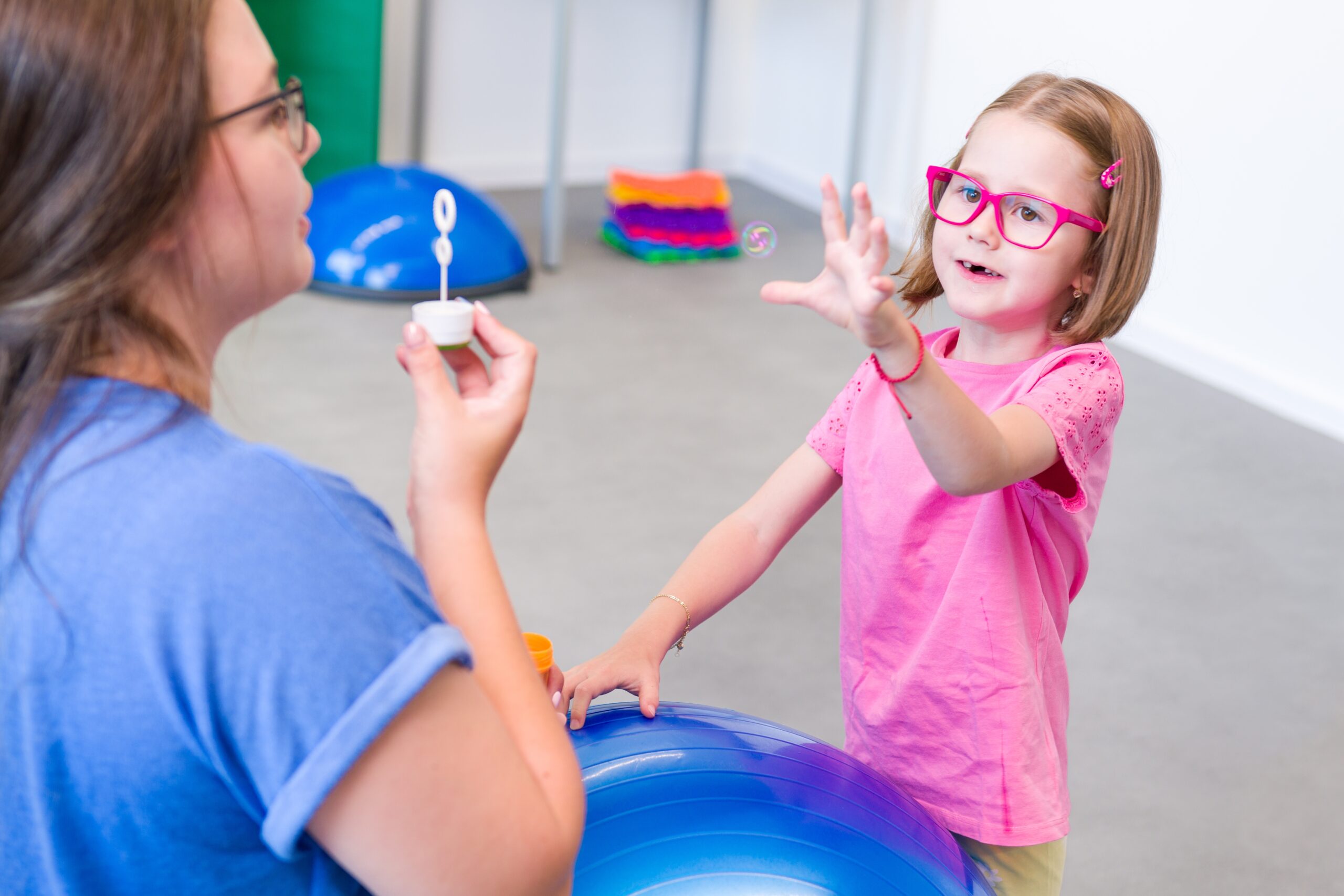
5 simple ways to encourage early communication (ages 0-3 years) during everyday routines.

Table Of Contents
The first three years of a child’s life are an incredible stage to promote communication and enrich your child’s vocabulary. Long before your child says their first word, they are already connecting the dots and building their language and communication inventory. They do this through connecting with their environment, which can look like them making eye contact, matching facial expressions, copying gestures, babbling and exploring shared experiences.
Building your child’s communication doesn’t automatically mean purchasing the most expensive toy or resource on the market. Creating opportunities for communication is often the most low-cost tool we can have in our back pockets. Some of the best opportunities can easily happen during everyday activities that you may already be doing with your little one, such as making breakfast, getting ready for the day, bathtime or even during a walk around your neighbourhood.
Below are 10 simple and low-cost ways to enhance and build on your growing child’s communication skills throughout their everyday routines.
- Following your child’s lead
- When engaging in play with your child, it is beneficial to observe what captures their attention and join in play with them. Child-led play could lead to an increase in engagement from the child and ultimately increase opportunities for communication (Roberts & Kaiser, 2011)
e.g. If your child is rolling a ball, roll one next to them
- Talk about what your child is doing
- Rather than asking your child questions about their play or observations, describe what they are seeing, experiencing and doing. (Hoff, 2006).
e.g. Instead of “what colour is the car?” Try: “You’re driving the Blue car. Zoooom, the car is Fast!”
- Getting down to their level
- Positioning yourself at eye level with your child enables them to view your facial expressions, gestures and mouth movements. Young children tend to learn communication by watching familiar faces; it helps to promote shared attention, social engagement, and even provides children with opportunities to observe speech movements. (Mundy & Newell, 2007)
e.g. Sitting face-to-face during song singing or sitting on the floor with them during play.
- Pause and wait
- Communication is a two-way interaction between individuals. Waiting after you have said something or offered a choice allows children additional processing time and increases opportunities for them to initiate communication. Responses from the little ones can often include looking, smiling, pointing, making a sound, or even saying a word (The Hanen Centre, n.d.).
- Creating opportunities to communicate
- As the caregiver, you often anticipate every need for your child; rather than doing that, try to create small opportunities for your child to communicate. These natural communication opportunities often encourage children to initiate meaningful interactions (Kaiser & Roberts, 2013).
e.g., putting their favourite toy out of reach, giving your child a closed snack they need help opening, offering two toy/ snack options
References:
Roberts, M. Y., & Kaiser, A. P. (2011). The effectiveness of parent-implemented language interventions: A meta-analysis.
Mundy, P., & Newell, L. (2007). Attention, joint attention, and social cognition.
The Hanen Centre. It Takes Two to Talk® principles.
Kaiser, A. P., & Roberts, M. Y. (2013). Parent-implemented naturalistic language intervention.
Hoff, E. (2006). How social contexts support and shape language development.

More from
the blog


Rotator Cuff Tears and Tendinitis: The Role of Exercise Physiology in Improving Shoulder Function
Read more →
Cervical Pathologies and Neck Pain: The Role of Exercise Physiology in Improving Health and Function
Read more →
Tips to keep
you moving well
Monthly insights on injury prevention, recovery, and everyday movement — straight to your inbox.